
The Shifting EV Market: U.S. Decline and Global Growth
Updated: May 4
Written by Christian Naida (Research Lead), Arsh Singh, Ajitesh Venkatesh
EXECUTIVE SUMMARY:
US EV sales have been slowing down in recent years after seeing solid growth in years prior are expected to be largely flat or a slight decrease in 2026 from 2025.
EV Sales in Europe and China continue to see strong growth with China experiencing more rapid growth than Europe. This is primarily due to the stronger government incentives to purchase EVs compared to the US.
The key driver in EV growth continues to be the amount of subsidy given to EV vehicles. With reductions in subsidy, we see slowing demand growth primarily due to the higher prices that consumers must pay compared to a traditional ICE vehicle.
In the future with better technology, the battery pack, the primary cost driver of an electric car, will fall in price. With advancements like these, EV demand will be less correlated to government subsidy and will see stronger demand growth.
Introduction
Over the past decade, electric vehicles (EVs) have emerged as a major solution to the reduction of carbon emissions within the automotive industry. With international governments and leading manufacturers promoting sustainability efforts, creating shifts in long-term production strategies and processes. All leading to EVs becoming more common in markets, with continued technological innovations and advancements, due to a growing embrace of environmental awareness. Within the US, EV production and sales grew rapidly beginning in the 2020s, all driven by new federal incentives and regulations during the Biden administration, along with a shift in consumer preferences.
Looking at the current day, the U.S. EV market has experienced a drastic shift, with a major slowdown in EV adoption, production, and growth in year over year sales. Occurring primarily due to changes in government regulations and incentives, rising production costs, and ongoing volatile supply chain issues. In particular, the average cost of an electric vehicle today still exceeds the cost of a new vehicle overall by over $10,000 (Kelley Blue Book), contributing to another barrier to entry into the EV market for many consumers. However, despite negative US trends, emerging EV growth globally highlights structural changes domestically.
EV Sales Trends in the United States
Electric Vehicle growth has continued to expand over the past decade, with a growing push for sustainability efforts by automakers and a shift in customer preferences. All possible through continued technological innovations, increased availability, and a push from federal policies. Resulting in a steady year-over-year growth in sales for 2014-2024, with a huge jump in 2021 with the introduction of the Biden administration and an increased focus on low-emission vehicle adoption in the US. Pushing EVs outside of the early adopters and into the mainstream market.

Despite the overall growth in EV sales for 2014-2024, recent market data from 2025 suggests a slowdown in EV momentum within the US market, with major US automakers and customer bases all responding to a changing economy and its regulatory conditions. Seen through a slip in year-over-year growth in sales from 2024-2025, as well as a slipping EV market share, signaling a slowdown in EV support and adoption from US customers. Emphasizing a shift in EV expansion from past administrations through regulatory incentives, towards more limited growth with a domestic market.

Figure 2: United States electric vehicle sales and market share from 2018-2025. However, 2025 we saw a downward shift, with both declining sales and market share from 2024 (Cox Automotive).
When viewing leading automakers within the industry, a clear difference in growth dynamics can be seen. For instance, while Tesla, the leader in EV sales, still controls a major amount of the market share, they have experienced declining sales over the past 2 years, with sales down by 7% in 2025 and 44,000 fewer units sold (Cox Automotive). Additionally, traditional automakers, such as Ford or General Motors, experience mixed performance in the EV department. General Motors recently took a $6 billion charge to scale back on EV production, following a troublesome Q4, where GM’s EV sales fell by 43% (The Wall Street Journal). Moreover, Ford has shifted away from EV production as well, cancelling production on its brand-new EV F-150 model, the Lightning, and transitioning EV truck plants into gas-powered plants (The Times Leader). This growing transition from EV production and declining sales continues to showcase potential downturns for EV adoption within the US.
Beyond firm-level decisions, customer behavior has played a significant role in shaping EV adoption and sales. A recent survey done by AP News reveals that 46% of adults are unlikely to purchase an EV, with 60% of respondents citing high prices (AP News). As financial incentives continue to be pushed back and upfront costs continue to increase, we can only expect a continued decline in consumer preferences for EV adoption.
EV Sales Trends in the Rest of the World
Developing Markets
EV Sales trends outside of the United States have looked quite different than the Sales trends we see in the United States. In other areas of the world outside of China, Europe and the United States we see limited but growing EV adoption. This is primarily due to the increased price of EVs compared to traditional ICE vehicles as well as limited range than EVs tend to have. In 2021 and 2022 we saw rapid EV growth year over year of 100% and 150% respectively but in more recent years we have seen more cooling demand as much of the hype has died down from EVs being initial brought to these markets but still sit at a growth rate of 25%-60% year-over-year. This will be a key area to watch as EVs prices continue to decrease and EVs are made more affordable for these emerging markets which could lead to strong demand in these regions.

Figure 3: A graph showing EV sales overtime from 2014 - 2024 in countries excluding China, Europe, and United States (IEA).
Europe
Europe has been one area that has adopted EVs to quite a high degree compared to other regions. This is primarily due to the lesser distances needed to be driven, the higher taxes ICE vehicles face, the high cost of gasoline for ICE vehicles, and high-quality charging infrastructure that is present around Europe. EVs really began to take off in Europe around 2018. This was largely coincided with the launch of the refreshed Nissan Leaf that was ideally sized for Europe’s smaller roads and streets while still having strong range and performance (WSJ). For three years after this into 2020 we saw EV sales double year over year due to the many advantages that EVs have mentioned before. In years after this however we see a slowing down in EV sales starting in 2021 were they drop down to 50% YoY growth continuing to decrease when in 2024 EV sales were flat at 2.2 million units sold in 2024.

Figure 4: A graph showing EV sales overtime from 2014 - 2024 in Europe (IEA)
China
China has been a bit of an outlier in terms of EV adoption and policy. China has heavily subsidized EVs more than almost any other country and therefore has high levels of EV sales primarily from homegrown brands like BYD, Xiaomi, and Nio. In 2021 EV sales dramatically increased in a similar way to Europe in 2018 with the introduction of the Wuling Hongguang a car made by a joint venture between GM and SAIC. This car was priced extremely competitively at a price ranging from $4,500 to $6,000 depending on the trim level (WSJ). This allowed electric cars to exploded in popularity and really reach the masses and go from something that only affluent people could afford in China to something that most people could afford. China has seen a slowing growth rate in their EV sales going from the 100% year-over-year sales increases seen in 2020 to now sales increasing at around 20% for 2023 and 2024. China today represents about half of the total EV demand in the world today making them a major player in EVs (IEA).

Figure 5: A graph showing EV sales overtime from 2014 - 2024 in China (IEA)
Looking across different regions, it is interesting to note how all regions have faced no growth or slowing growth in the last two years of EV sales. This primarily is tied to how most countries have been reducing their amount of EV subsidies increasing the cost of these vehicles (Bloomberg). More broadly high interest rates impact sales of these EVs and make the payment on these vehicles making them even more expensive compared to the low interest rates of the early 2020s just after the COVID-19 pandemic. All these factors have led to EV sales figures that have been slowing broadly.
Changes in EV Regulations
Changes in EV regulations have caused large changes in the demand for EVs though tax credits and other subsidy programs. In the United States there has been a large change in the amount of subsides for electric vehicles. Recently under the most recent 2026 budget bill passed this year the $7,500 dollar tax credit was removed making EVs broadly much more expensive (Reuters). With cost often being one of the most important factor for buyers in a competitive automotive market (Statista); this can make a EV a difficult choice to justify for a potential customer when a comparable ICE model is about 8-9 thousand dollars cheaper for a comparable type of model (Kelley Blue Book).
In other regions like Europe and Asia regulations are much more favorable to EVs and strong incentives still exist to incentivize EV ownership. Europe has primary done this though exemptions of certain carbon taxes placed on automobiles since EVs do not emit any sort of harmful emissions into the environment. This has led certain countries like Norway to have 95.9% of new car sales be electric (Reuters). Overall EVs have seen strong adoption in Europe because of these policies and expected to continue to see strong growth in EV adoption over the coming years.
China has been a real outlier in regulation with EVs they have heavily subsidized there EV industry creating one of the most competitive homegrown EV industries anywhere in the world. The types of subsidizes are numerous given to both consumers and companies that buy and produce EVs (Reuters). They often range from simple subsidies like we saw in the US like tax credits to complex systems like the CAFC tax credit system which requires traditional ICE cars makers to buy tax credits from EV car makers making traditional ICE vehicles more expensive and EV more attractive in terms of price point.

Figure 6: A graph showing the amount of subsidies in China, Europe and United States for EVs (IEA)
We broadly from this graph that overall EV subsides in across the board are decreasing as shown by the orange line. The EV market seems more decoupled subsidies as EV markets became more mature.
Logistics and Manufacturing Issues
There have been high costs due to EV cost cutting production, and this remains a major challenge for the electric vehicle industry. Batteries account for over 30% of total vehicle costs, making the procurement of raw materials and price stability key factors for companies that still want to remain competitive in the market.
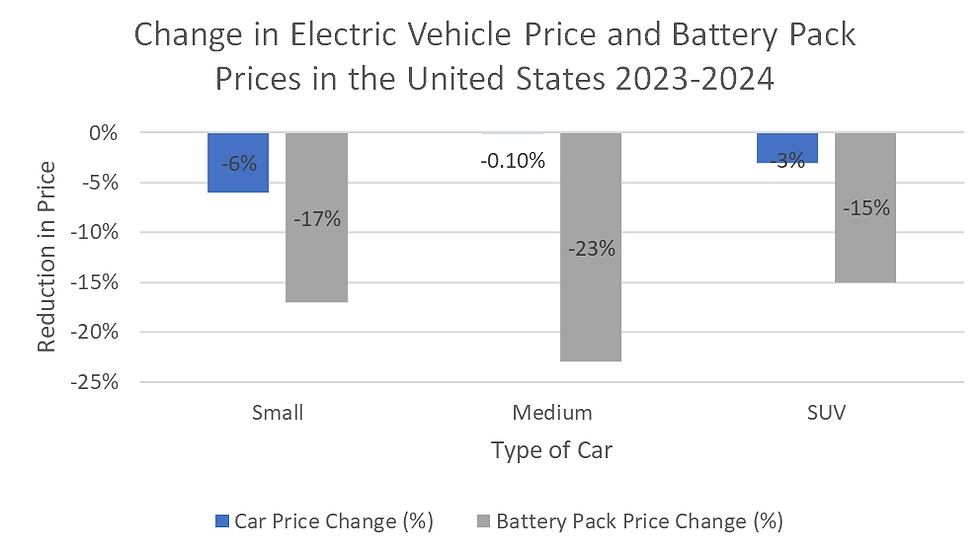
Figure 7: A graph showing the change in car and battery pack prices (IEA)
While manufacturers still struggle with costs and other distribution issues, Chinese EV makers hold a strong advantage in their massive domestic supply chain and their ability to scale production effectively. This overall ability allows Chinese firms to achieve costs approximately 20% lower than the international competitors they're faced with. further making sure that companies like profitable CATL, which has recently increased its gold battery market share by 36.8%.
There are many financial pressures that are being enforced by automakers. These companies employ many strategic approaches. An example of this is Tesla's high-end models that command a large profit margin by providing a financial setback to support its lower price and loss leader vehicles. The lost leader strategy normally implemented by the and high end retail stores is an idea of having a lower marketed down product to overall boosted sales of vehicles and appliances around the product Meanwhile the industry at large is trying to optimize supply chains and offset the idea of high retail material prices for procurement as the market grows in demand the ability to control battery costs and leverage the idea of having domestic supply chains will likely cause an issue which manufacturers can survive with aggressive price competition and the shift towards more electric vehicle environment.
Future Innovation and Advancement
The next generation of electric vehicles will be defined by a breakthrough in sustainable sourcing. A major area of development is a transition from traditional graphite batteries to a more silicone-based technology, which promises a greater internal energy storage while being integrated into major automotive production lines. The industry is slowly shifting towards more ethical practices and more efficient supply chain manufacturers and is expected to invest over $1 billion into facilities to improve the innovative mining techniques and the recovery of raw procurement materials. This is supported by digital sourcing and way more sustainable practices to ensure EV components are brightly placed into future production of vehicles.
Technology advancement is also moving beyond the hardware of the battery itself; it's moving towards a realm of intelligent management and focusing more on the infrastructure of the product. The market for BMS, known as smart battery management systems, is expanding at a rapid pace. This sector is projected to reach a valuation of $41 billion by 2032 with an annual growth rate of 19.1%. Overall, building supply chains' resilience is a top priority in the United States, especially in the EV car market. This includes A projected need for 80 to 60 GW in a virtual power plant known as a VPP by 2030. This would account for over 20% of the peak load and ensure the widespread adoption of advanced EV technology overall.
Conclusion
The current EV market indicates a period of divergence between the US market and the broader global landscape. The US EV market continues to face a decline due to changing federal incentives and regulations, along with conflicting consumer behaviors arising due to rising costs. Sequentially, top US automakers have begun to scale back on EV production, with many, such as Ford and General Motors, showing an emphasis on shifting back towards gas-powered vehicles. Nonetheless, global EV adoption continues to grow at a stable pace, supported by strong manufacturing capacity and both consumer and regulatory support.
Looking ahead to the future of the EV market within the US, we can expect the administrative direction, production costs, and continued technological innovation to all control the pace of success for EVs domestically. Current and future federal policies play an essential role in both setting expectations through federal incentives and setting sustainability standards for automakers. Though we see continued success for EVs globally, it is still uncertain what their future is domestically with EV adoption. However, the long-term success of EVs will rely on alignment with administration, technological advancements, and overall infrastructure expansion from leading automakers.



Comments